How Custom Mobile Apps Help Tucson Businesses

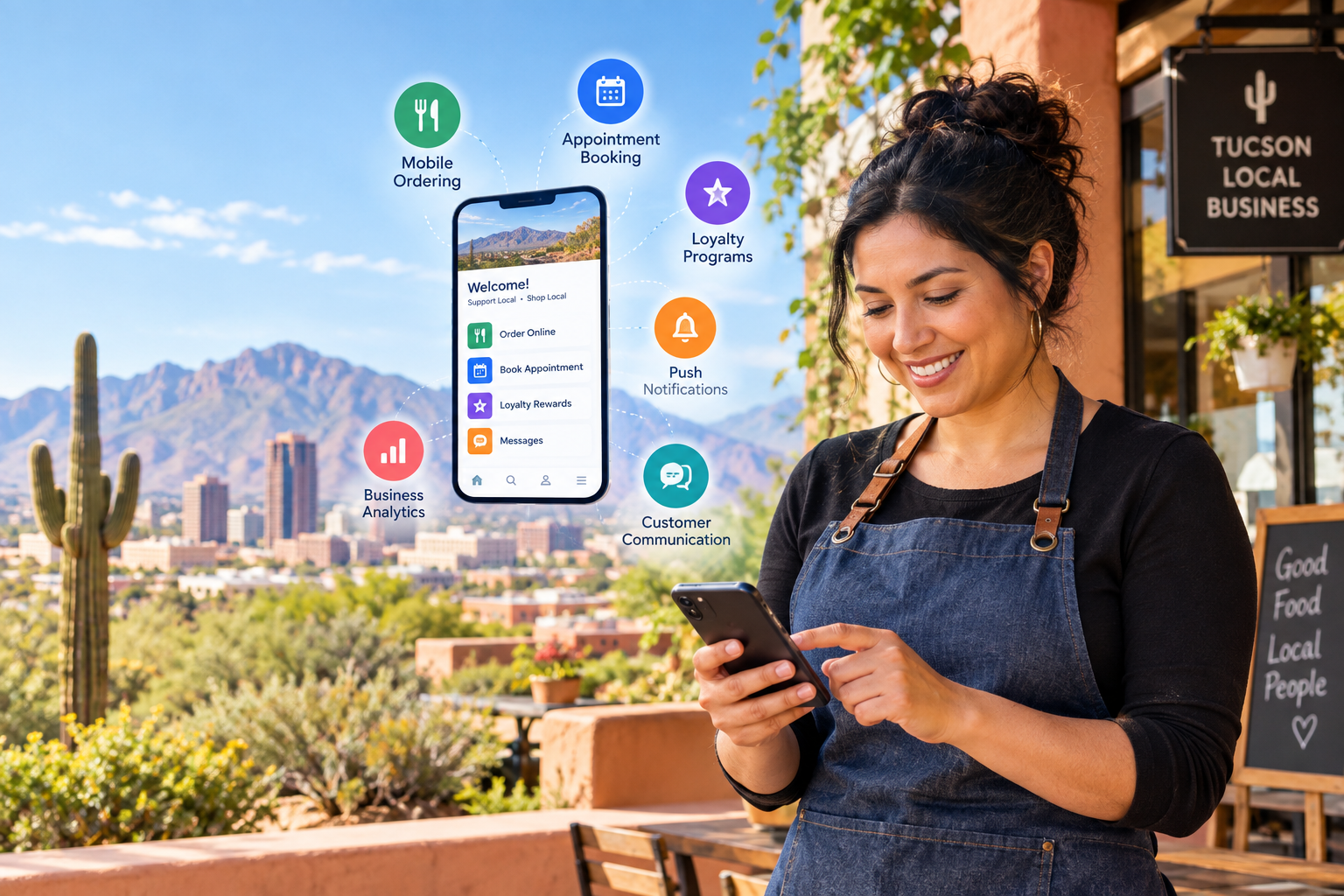
Tucson is home to a diverse and growing business community, from restaurants and retail stores to professional services, healthcare providers, tourism businesses, and startups. The Tucson metropolitan area has more than 93,000 small businesses, making digital customer engagement increasingly important for local companies.
A custom mobile app can give Tucson businesses a direct digital channel for communicating with customers, promoting services, accepting orders or bookings, and building long-term relationships.
What Is a Custom Mobile App?
A custom mobile app is a mobile application designed specifically around a business's products, services, customers, and operational requirements. Unlike a generic application, a custom app can include features that directly support a company's business model.
For example, a Tucson restaurant might use an app for online ordering and loyalty rewards, while a salon could offer appointment scheduling, reminders, and customer profiles. A local retailer could use an app for product browsing, promotions, mobile shopping, and personalized notifications.
Why Tucson Businesses Can Benefit From Custom Mobile Apps
Technology adoption is already widespread among Arizona small businesses. According to the U.S. Chamber of Commerce's 2025 small-business report, 100% of surveyed Arizona small businesses used at least one technology platform, while 93% planned to increase their technology use over the following two to three years.
For Tucson businesses, a custom mobile app can complement an existing website, social media presence, and other digital channels.
1. Build a Direct Customer Connection
A mobile app creates a direct communication channel between a business and its customers.
Businesses can use in-app notifications to announce new products, limited-time offers, upcoming events, appointment reminders, or important updates. This can reduce reliance on customers discovering every update through search engines or social media.
2. Make Ordering and Booking Easier
Businesses can simplify common customer actions through mobile features.
Restaurants can provide mobile ordering and pickup options. Salons and wellness businesses can offer appointment scheduling. Professional service providers can allow customers to request consultations or submit service inquiries.
Reducing unnecessary steps can make the customer experience more convenient.
3. Create Mobile Loyalty Programs
A custom app can turn traditional loyalty programs into a digital experience.
Businesses can provide points, rewards, digital memberships, referral incentives, or personalized offers. Customers can view their rewards directly from their phones instead of carrying physical loyalty cards.
4. Improve Customer Engagement
Mobile apps can provide multiple ways for businesses to stay connected with customers.
Depending on the business model, an app can support:
- Customer accounts and profiles
- Push notifications
- In-app messaging
- Appointment reminders
- Order updates
- Loyalty rewards
- Product recommendations
- Feedback and reviews
- Digital memberships
These features can help businesses create a more consistent customer experience.
5. Support Local Retail and Restaurants
Tucson's business ecosystem includes restaurants, retail concepts, galleries, entertainment businesses, and other customer-facing companies. Downtown Tucson alone reported more than a dozen new restaurant, bar, gallery, and retail openings between January and July 2026.
For these businesses, mobile apps can support features such as digital menus, online ordering, reservations, product catalogs, promotional campaigns, loyalty programs, and location information.
6. Personalize the Customer Experience
Custom applications can use customer preferences and permitted behavioral data to provide more relevant experiences.
For example, a retail app could recommend products based on previous purchases. A restaurant could highlight frequently ordered items, while a service business could display upcoming appointments and personalized offers.
Businesses should collect and use customer data responsibly and provide appropriate privacy controls.
7. Provide Business Insights
A custom mobile app can also generate useful operational and customer insights.
Depending on the features implemented, business owners can analyze information such as:
- App engagement
- Popular products or services
- Booking activity
- Order patterns
- Loyalty participation
- Customer preferences
- Promotional campaign interactions
These insights can help businesses make more informed decisions about their digital customer experience.
Mobile Apps Can Support Different Tucson Business Types
A custom mobile application doesn't have to follow one standard model. Its features can be adapted to the business.
Restaurants: Online ordering, reservations, digital menus, loyalty rewards, delivery updates, and promotions.
Retail stores: Mobile shopping, product catalogs, loyalty programs, personalized offers, and order tracking.
Salons and wellness businesses: Appointment booking, reminders, service catalogs, memberships, and customer profiles.
Healthcare businesses: Appointment requests, reminders, secure communication, educational content, and patient-oriented services where appropriate.
Real estate businesses: Property listings, saved searches, notifications, inquiries, and appointment requests.
Professional services: Consultation requests, scheduling, customer accounts, documents, notifications, and communication tools.
Education and tutoring businesses: Class schedules, learning resources, notifications, assignments, and communication.
How AI Can Add More Value to a Custom Mobile App
AI can be incorporated into mobile applications when it serves a clear business purpose.
For example, an app could use AI for personalized product recommendations, automated customer support, content recommendations, search assistance, or customer-service workflows.
Arizona businesses are already showing significant interest in AI. The U.S. Chamber report found that 64% of surveyed Arizona small businesses were using an AI platform, while 81% believed AI would help their businesses in the future.
For Tucson businesses considering an app, AI can therefore be evaluated as an optional component rather than something that needs to be included simply because it is a current technology trend.
What Features Should a Tucson Business App Include?
The right features depend on the business's goals. A typical custom app may include:
- User registration and login
- Customer profiles
- Product or service catalogs
- Online ordering
- Appointment scheduling
- Secure payments
- Push notifications
- Loyalty and rewards
- In-app messaging
- Location and map integration
- Reviews and feedback
- Analytics dashboards
- AI-powered recommendations
- Admin management
A business does not necessarily need all of these features. Starting with the functions that solve real customer problems can make the development process more focused.
How to Plan a Custom Mobile App
Before development begins, Tucson businesses should define what the app is expected to accomplish.
Start by identifying the primary customer problem, followed by the most important business objective. Then determine the minimum set of features needed for the first version.
A typical process includes:
1. Define the business objective: Determine whether the primary goal is ordering, booking, customer engagement, sales, communication, or another business requirement.
2. Research customers: Understand how customers currently interact with the business and where they experience friction.
3. Prioritize features: Separate essential features from functionality that can be added later.
4. Design the user experience: Create simple navigation and mobile-friendly interfaces.
5. Develop and integrate: Build the application and connect necessary systems such as payments, scheduling, CRM, inventory, or analytics.
6. Test the application: Test functionality, security, usability, and performance across supported devices.
7. Launch and improve: Monitor usage and customer feedback, then release improvements over time.
Custom Mobile App Development in Tucson
For businesses evaluating Custom Mobile App Development in Tucson, the most important consideration is not simply having an app in the App Store or Google Play. The application should solve a specific customer or operational problem.
A well-planned app can become an extension of a business's website and other digital channels, giving customers another convenient way to interact with the company.
For businesses looking for Mobile App Development Services in Tucson, the development approach should consider the target audience, required features, integrations, security requirements, scalability, and ongoing maintenance.
Final Thoughts
Custom mobile apps can give Tucson businesses a dedicated platform for customer engagement, ordering, bookings, loyalty programs, communication, personalization, and business insights.
The best starting point is to identify a genuine customer need and build the app around that need. With Tucson's large small-business community and Arizona's growing adoption of technology and AI, businesses can evaluate mobile applications as one component of a broader digital strategy.
Read Also


Jun 13, 2022
4 Best Membership WordPress Plugins
Having a membership website will increase your reputation and strengthen your engagement w


Comments (0)