How Custom Mobile App Helps Businesses in Arizona
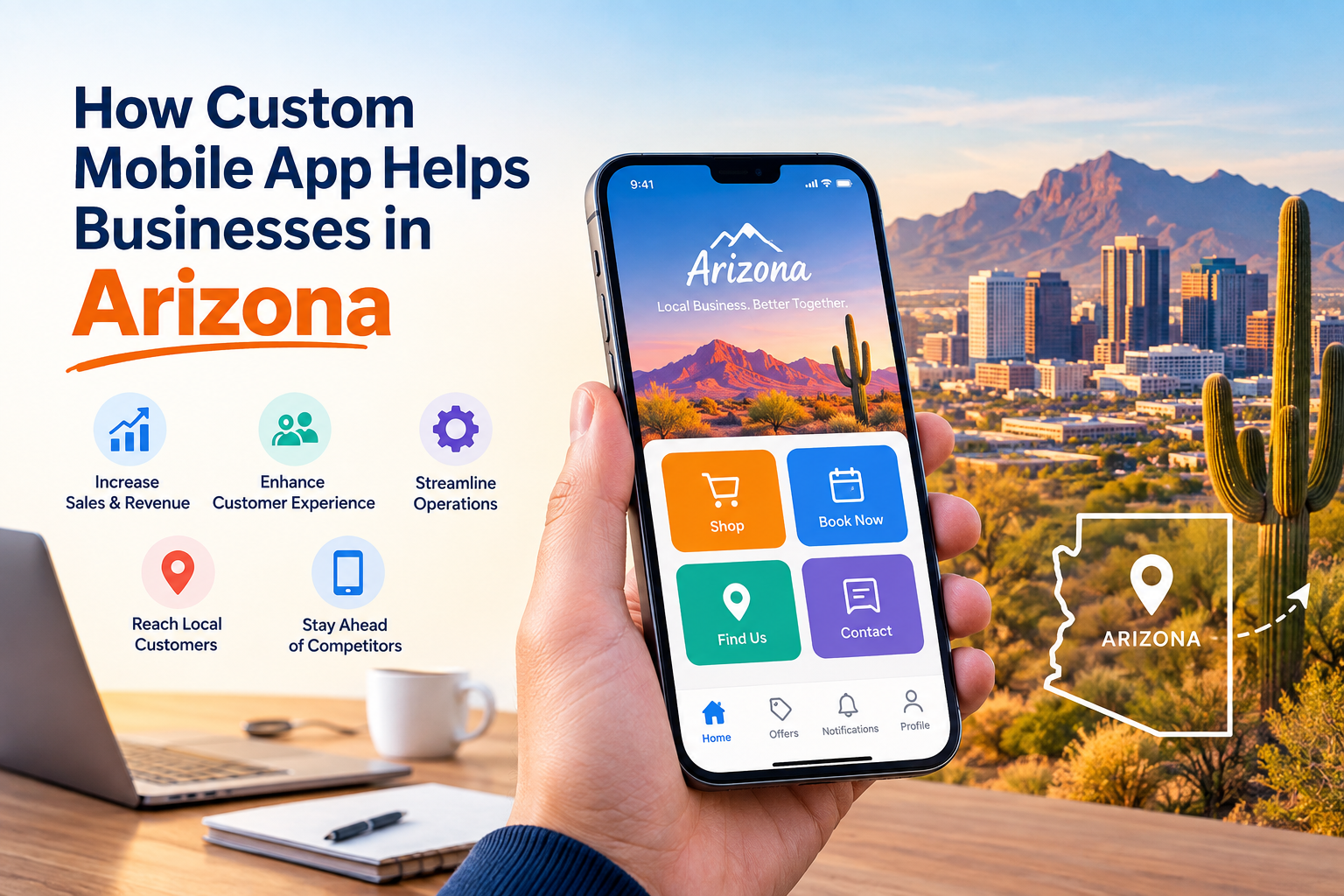
Arizona’s business landscape is becoming increasingly digital, with companies across Phoenix, Tucson, Scottsdale, Tempe, Mesa, Chandler, Glendale, and other cities adopting technology to improve customer experiences and streamline operations. From small businesses and startups to established enterprises, mobile applications can provide a direct digital channel for customers, employees, and business operations.
A custom mobile app is designed around a company’s specific goals, workflows, customers, and industry requirements rather than forcing the business to adapt to a generic solution. For Arizona businesses competing in a technology-driven market, this can create opportunities to improve engagement, automate processes, and build stronger customer relationships.
According to current industry directories, Arizona has a substantial and growing mobile-app development ecosystem, with dozens of firms providing mobile development services across the state.
What Is a Custom Mobile App?
A custom mobile app is a software application developed specifically for a business or organization. Unlike an off-the-shelf application, it can be designed around particular business processes, customer requirements, branding, integrations, and security needs.
For example, an Arizona healthcare provider might need appointment scheduling, patient communication, and telehealth functionality, while a construction company may need project tracking, employee communication, document management, and field reporting.
The goal is to create an application that solves specific business problems instead of simply adding another generic digital tool.
Why Arizona Businesses Are Investing in Mobile Apps
Arizona has a diverse economy that includes technology, healthcare, tourism, real estate, construction, professional services, retail, logistics, manufacturing, and agriculture. These businesses often have different operational requirements, making customized digital solutions valuable.
Arizona is also actively supporting technology-driven entrepreneurship and innovation. The Arizona Commerce Authority provides programs designed to support technology-focused startups and small businesses, while state initiatives are increasingly incorporating digital transformation and emerging technologies.
A mobile application can help businesses respond to these changing expectations by providing customers and employees with convenient access to services and information.
7 Ways a Custom Mobile App Helps Businesses in Arizona
1. Improves Customer Engagement
A mobile app gives businesses a direct communication channel with their customers.
Instead of relying exclusively on websites, email, or social media, companies can provide customers with personalized services through an application. Features such as push notifications, loyalty programs, personalized recommendations, appointment reminders, and in-app messaging can encourage customers to interact with a business more frequently.
For local businesses in Phoenix, Tucson, Scottsdale, and surrounding communities, an app can also support location-specific promotions and services.
2. Creates a More Convenient Customer Experience
Customers increasingly expect businesses to provide fast and convenient digital experiences.
A custom application can bring multiple services into one place. Depending on the business model, customers may be able to:
- Book appointments
- Place orders
- Make payments
- Track deliveries
- Request services
- Access accounts
- Receive notifications
- Contact support
- Manage subscriptions
- View personalized recommendations
For example, a restaurant could allow customers to order food and track deliveries, while a healthcare provider could allow patients to schedule appointments and receive reminders.
3. Automates Business Operations
Mobile applications are not only useful for customers. They can also simplify internal operations.
Businesses can develop apps for employees, sales representatives, technicians, drivers, managers, and field workers. Instead of relying on spreadsheets, phone calls, emails, or disconnected systems, employees can access relevant information from a centralized application.
For example, a field-service company could use an app for job assignments, technician check-ins, customer information, photos, invoices, and service reports.
This type of automation can reduce repetitive administrative work and help employees access information faster.
4. Provides Real-Time Business Data
A custom mobile app can connect with business systems and provide real-time information to authorized users.
Managers can use mobile dashboards to monitor metrics such as:
- Sales
- Orders
- Customer activity
- Inventory
- Appointments
- Employee performance
- Service requests
- Revenue
- Operational activity
Real-time information can help business owners make decisions based on current business activity rather than relying entirely on delayed reports.
5. Supports Personalized Experiences
One major advantage of custom applications is the ability to tailor experiences according to customer behavior and preferences.
Businesses can use application data to deliver relevant content, offers, recommendations, and notifications.
For example, an eCommerce business could recommend products based on browsing or purchase behavior. A fitness application could provide customized workout recommendations, while a restaurant application could highlight frequently ordered meals.
Personalization can make digital interactions more relevant and useful for customers.
6. Integrates With Existing Business Systems
A custom mobile application does not necessarily need to operate independently.
It can be integrated with systems such as:
- CRM platforms
- ERP software
- Payment gateways
- eCommerce platforms
- Inventory systems
- Accounting software
- Marketing platforms
- Cloud services
- Customer support systems
- Analytics platforms
This integration can create a connected digital ecosystem where information moves between systems instead of being manually entered multiple times.
7. Helps Businesses Build a Scalable Digital Product
A custom app can be developed with future business growth in mind.
Businesses can start with essential functionality and gradually introduce additional features such as AI-powered recommendations, advanced analytics, loyalty programs, chatbots, automation, wearable-device integration, or IoT connectivity.
This approach allows an application to evolve as customer expectations and business requirements change.
Industries in Arizona That Can Benefit From Custom Mobile Apps
Custom mobile applications can be applied across many Arizona industries.
Healthcare
Healthcare providers can use apps for appointment scheduling, patient communication, prescription reminders, telehealth, health records, and notifications.
Real Estate
Real estate companies can provide property searches, saved listings, appointment scheduling, agent communication, and property alerts through mobile applications.
Restaurants and Food Services
Restaurants can use apps for online ordering, reservations, loyalty programs, digital menus, payments, and delivery tracking.
Retail and eCommerce
Retail businesses can offer mobile shopping, personalized recommendations, loyalty rewards, order tracking, mobile payments, and customer notifications.
Construction
Construction companies can use mobile applications for project management, field reporting, employee communication, task management, documentation, and progress tracking.
Logistics
Transportation and logistics businesses can develop apps for delivery tracking, route management, driver communication, proof of delivery, and customer notifications.
Professional Services
Law firms, financial companies, consulting firms, and other professional service providers can use apps for client communication, document access, appointment scheduling, secure messaging, and account management.
Custom Mobile App Development in Arizona: What Businesses Should Consider
Before starting a mobile application project, businesses should clearly define the problem the application needs to solve.
Important considerations include:
Target users: Identify whether the application is intended for customers, employees, partners, or multiple user groups.
Core functionality: Determine the essential features required for the first version.
Platform: Decide whether the app should support iOS, Android, or both.
Integrations: Identify existing software and third-party services that need to connect with the application.
Security: Consider authentication, authorization, encryption, secure data storage, and privacy requirements.
Scalability: Plan the technical architecture so the application can support increasing users and functionality.
Analytics: Define which business and user metrics need to be measured.
Maintenance: Consider ongoing updates, security patches, performance improvements, and operating-system compatibility.
How Much Does a Custom Mobile App Cost in Arizona?
The cost of developing a custom mobile app in Arizona varies significantly based on its functionality and technical complexity.
A relatively simple application with a limited number of screens and basic functionality will generally require less development effort than an enterprise application involving real-time data, payment processing, AI, complex integrations, multiple user roles, or extensive backend infrastructure.
The total cost can depend on:
- Number of features
- UI/UX design requirements
- iOS and Android development
- Backend development
- API integrations
- Third-party services
- Security requirements
- Testing
- Cloud infrastructure
- Maintenance and updates
Therefore, businesses should define their requirements before comparing development estimates. Industry directories currently show a wide range of pricing among Arizona app-development providers, reflecting differences in project complexity and service models.
How to Start a Custom Mobile App Project
Arizona businesses can follow a structured process when planning a mobile application:
- Define the business problem
- Identify the target audience
- Research competitors and customer expectations
- List essential features
- Create user flows and wireframes
- Design the user interface
- Select the technology stack
- Develop the application and backend
- Integrate required systems
- Perform functional and security testing
- Launch the application
- Monitor performance and continuously improve it
Starting with a focused Minimum Viable Product (MVP) can also help businesses validate an idea before investing in a larger application.
Frequently Asked Questions
What are the main benefits of a custom mobile app for an Arizona business?
A custom mobile app can improve customer engagement, automate business processes, provide real-time information, support personalization, integrate with existing systems, and create a scalable digital platform.
Is a mobile app useful for small businesses in Arizona?
Yes. Small businesses can use mobile applications for appointment booking, ordering, payments, loyalty programs, customer communication, service requests, and other processes. The key is to develop functionality that addresses a genuine customer or operational need.
Should an Arizona business build an iOS or Android app?
The choice depends on the target audience, customer demographics, business objectives, and budget. Businesses targeting both major mobile ecosystems may consider cross-platform development or separate native applications.
Can a custom mobile app use AI?
Yes. Depending on the use case, AI can support recommendation systems, chatbots, personalization, predictive analytics, document processing, image recognition, voice features, and workflow automation.
How long does it take to develop a custom mobile app?
Development time depends on the application's scope, number of platforms, integrations, design requirements, backend complexity, and testing requirements. A basic MVP generally requires less time than a feature-rich enterprise application.
Final Thoughts
For Arizona businesses, a mobile application can be much more than a digital extension of a website. When designed around specific business objectives, it can become a platform for customer engagement, operational automation, personalized services, data-driven decisions, and long-term digital growth.
The most effective approach is to begin with a clear business problem, identify the features that directly address it, and build an application that can evolve as the business grows. With Arizona's expanding technology and startup ecosystem, businesses across industries have opportunities to use mobile technology to create more connected and convenient experiences for their customers and teams.
Read Also


Jun 13, 2022
4 Best Membership WordPress Plugins
Having a membership website will increase your reputation and strengthen your engagement w


Comments (0)